
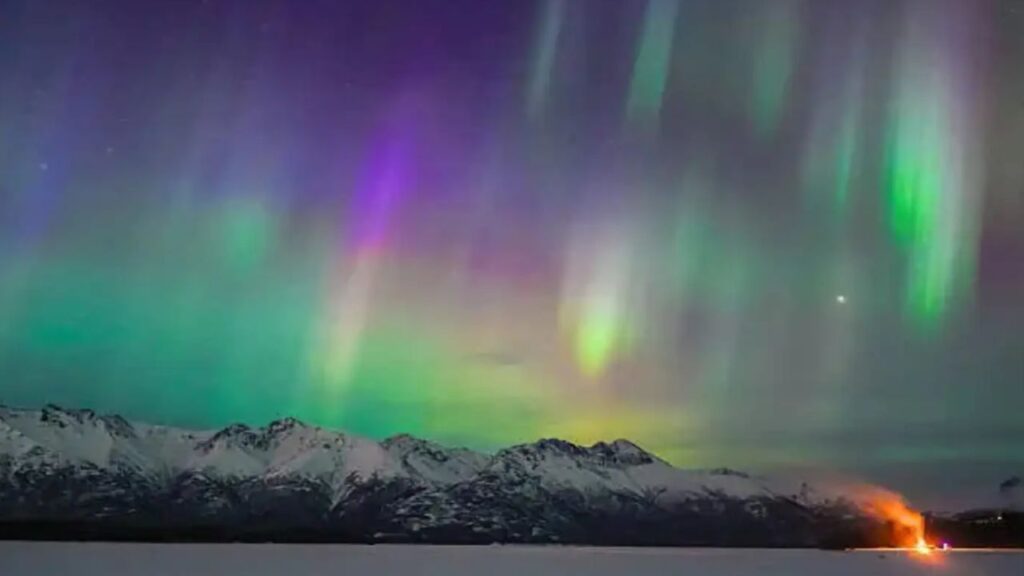
Bismarck, North Dakota — Skywatchers across parts of the northern United States could get an opportunity to see the northern lights this Halloween weekend as incoming high-speed solar winds increase the chances of aurora activity.
According to the National Oceanic and Atmospheric Administration (NOAA), the aurora could become visible across several states near the U.S.-Canada border on Friday night and into early Saturday. The latest forecast points to a potential increase in geomagnetic activity as high-speed solar winds from a coronal hole reach Earth.
Although visibility is not guaranteed, people in northern locations with clear skies and limited light pollution may have an opportunity to catch the colorful display.
NOAA Forecast Shows Increased Northern Lights Activity
NOAA is predicting a Kp index of 5 out of 9 on Friday night, indicating stronger geomagnetic activity that could make the northern lights brighter and potentially visible farther south than usual.
The forecast attributes the expected activity to high-speed solar winds coming from a coronal hole on the Sun.
A coronal hole is an area of the Sun that is cooler and less dense than its surroundings. It appears darker in extreme ultraviolet images and can release streams of fast-moving solar wind into space.
When these charged particles interact with Earth’s magnetic field, they can trigger geomagnetic disturbances and increase aurora activity.
NOAA’s three-day forecast also indicates the possibility of minor geomagnetic storms early Saturday morning. These conditions could improve the chances of seeing the aurora across parts of the northern United States.
Thursday night, however, is expected to offer less favorable conditions, with NOAA predicting a Kp index of just 2.
Which States Could See the Northern Lights?
According to NOAA’s forecast map, the likelihood of aurora visibility on Friday night is classified as low across several northern U.S. states. However, residents in darker locations may still have an opportunity to spot the display if conditions cooperate.
The potential viewing areas include:
- Washington: Northeastern parts of the state.
- Idaho: Northern Idaho.
- Montana: Most of the state.
- North Dakota: Northern and other areas within the forecast visibility region.
- South Dakota: Northern portions of the state.
- Minnesota: Parts of the state, particularly farther north.
- Wisconsin: Northern areas could have a viewing opportunity.
- Michigan: The Upper Peninsula is among the areas to watch.
- Alaska: Most of the state falls within the high-visibility region.
The forecast does not mean everyone in these states will see the aurora. Actual visibility will depend on cloud cover, local weather, light pollution and how geomagnetic activity develops.
People living farther north generally have better opportunities because they are closer to the region where auroras commonly occur.
What Is the Best Time to See the Northern Lights?
Timing and location can make a significant difference when trying to view the aurora.
Another 5 Inches of Rain Possible in Hawaii as Flood Concerns Grow Across Maui and the Big Island
NOAA recommends moving toward locations with a clear view of the northern sky. Open areas, hills and elevated locations can offer better viewing conditions, particularly when buildings, trees and other obstacles do not block the horizon.
The hours around midnight are often among the most active periods for aurora viewing.
The recommended viewing window is approximately 10 p.m. to 2 a.m. People hoping to see the display should consider these tips:
- Choose a location away from city lights and brightly illuminated roads.
- Find an open area with an unobstructed northern horizon.
- Check local cloud cover before heading outside.
- Allow your eyes time to adjust to the darkness.
- Monitor updated aurora forecasts because geomagnetic activity can change quickly.
Even when the forecast indicates favorable conditions, the northern lights may appear briefly or remain too faint to see with the naked eye.
What Could Affect Halloween Weekend Aurora Viewing?
The biggest factors will be the arrival and strength of the incoming solar wind, local cloud cover and the amount of light pollution.
A Kp index of 5 can create opportunities for aurora visibility farther from the magnetic north pole, but it does not guarantee that the lights will appear in every state included in the forecast.
Weather conditions could also make a difference. Even strong geomagnetic activity will not provide a clear view if clouds cover the sky.
Skywatchers should check updated NOAA forecasts and local weather conditions before planning a late-night viewing trip.
Are you planning to watch for the northern lights this Halloween weekend? Which state will you be viewing from? Share your location and let us know if you manage to spot the aurora!






One thought on “Northern Lights May Be Visible Across Northern U.S. This Halloween Weekend, NOAA Forecast Says”