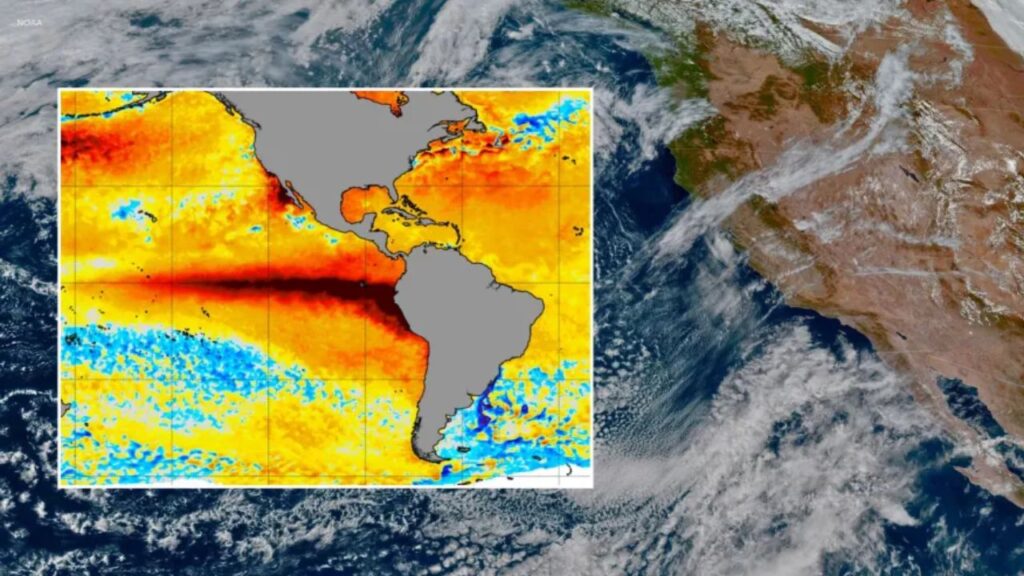
Los Angeles, California — A powerful El Niño developing in the Pacific is raising growing concerns about California’s upcoming winter, with climate experts warning that unusually warm ocean temperatures could set the stage for excessive rainfall, flooding, mudslides and dangerous coastal conditions.
Warnings about the developing “super” El Niño have intensified in recent months, with government officials and weather experts increasingly focused on what the climate pattern could mean for California.
The potential impacts are already being seen in the Pacific, while forecasters say the greatest concern could come during the winter months.
Climate Scientist Says He Is ‘Officially Concerned’
Daniel Swain, a prominent climate scientist with UC Agriculture and Natural Resources, issued his strongest warning yet Tuesday after reviewing the latest forecast models.
“Based on what I am seeing now, I am officially concerned,” Swain said, pointing to growing confidence that California could experience a very wet winter.
His warning comes as sea surface temperatures across the tropical Pacific have climbed dramatically.
Temperatures along the equator are reportedly more than 3 degrees Celsius above average, an unusually large departure that has become a major focus for climate scientists monitoring the developing El Niño.
NOAA said in an advisory last month that the event is expected to continue strengthening through the end of the year. The agency also estimated a 75% chance of a historic event capable of surpassing the strength of recorded El Niño events dating back to 1950.
‘The Warning Lights Are Flashing’
Swain has emphasized just how unusual the current conditions could become.
“We’ve never seen an event this big before in the context of our rapidly warming climate … The warning lights are flashing,” Swain said.
The combination of an exceptionally strong El Niño and a warming climate has raised questions about whether California could face more extreme precipitation and weather impacts than during previous events.
However, scientists continue to stress that El Niño itself does not guarantee a wet winter.
Swain noted that the climate pattern raises the likelihood of above-average precipitation, rather than guaranteeing that California will experience a specific amount of rain.
Still, the latest forecast models have shown an unusually strong level of agreement.
Southern California Has Already Felt El Niño’s Influence
Some effects of the developing climate pattern have already appeared along the Southern California coast. Pacific hurricanes, including Hurricane Marie, generated large waves and storm surges that battered coastal communities.
The unusual ocean conditions have also been associated with an influx of marine life farther north than normally expected.
Hammerhead sharks, Chilean manta rays, whale sharks and Eastern Tropical Pacific orcas have been spotted in greater numbers in Southern California waters.
An Olive Ridley sea turtle also made headlines after laying eggs in Huntington Beach, an extremely unusual sight for the area.
While the appearance of rare marine species has fascinated residents and scientists, the potential weather consequences of the same ocean pattern are considerably more concerning.
Flooding and Mudslides Are Major Concerns
A particularly strong El Niño can increase the risk of dangerous weather across California.
National Weather Service Head Meteorologist Dr. Ariel Cohen warned that very strong El Niño events can increase the odds of flash floods, burn-scar debris flows, severe thunderstorms, damaging winds and tornadoes.
Coastal communities could also face coastal flooding, beach erosion and dangerous rip currents. Wildfire burn scars are especially vulnerable because damaged landscapes can quickly become overwhelmed when intense rainfall arrives.
That has prompted officials to begin preparations before the worst of the winter weather potentially arrives.
California Begins Preparing for a Potentially Wet Winter
California Gov. Gavin Newsom has already declared a state of emergency, reflecting the concern surrounding the developing weather pattern.
Los Angeles officials have also been discussing potential El Niño impacts and preparedness measures with representatives from the National Weather Service.
Mayor Karen Bass said crews are working to clear storm basins and drainage systems while reinforcing hillsides that could be vulnerable to debris flows.
Those preparations are particularly important in areas affected by previous wildfires, where heavy rain can rapidly turn unstable slopes into dangerous debris flows.
Forecast Confidence Is Raising New Concerns
Despite the uncertainty that always surrounds long-range weather forecasts, Swain said the latest models are unusually consistent.
“I’ve never seen such high predictive confidence in a very wet California winter,” he said. “This kind of outlook is one reason why California’s pre-emptive emergency declaration, I think, is justified.”
For Californians, the coming months could bring a complicated mix of benefits and risks. Additional precipitation could help ease drought concerns in some areas, but too much rain arriving too quickly could create flooding, mudslides and significant coastal hazards.
With ocean temperatures remaining exceptionally warm and forecasts continuing to point toward a potentially historic El Niño, attention is now turning toward how the pattern evolves as winter approaches.
Do you think California is prepared for a potentially historic El Niño winter? Share your thoughts in the comments and let us know what weather impacts you are most concerned about.