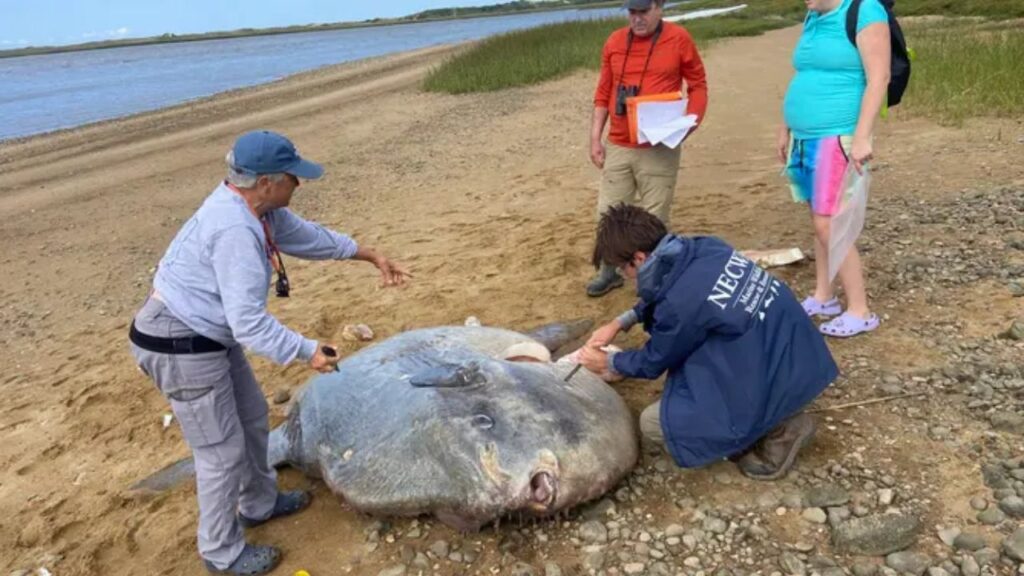
Wellfleet, MA — A massive ocean sunfish estimated to weigh more than 900 pounds was found dead on a Cape Cod beach earlier this week, creating a striking and heartbreaking sight along the Massachusetts shoreline.
The adult female sunfish washed ashore at the mouth of the Herring River in Wellfleet, along Cape Cod’s inner shore bordering Cape Cod Bay. Someone walking along the shoreline discovered the enormous fish stranded on the beach.
Ocean sunfish are among the ocean’s most distinctive giants. They are known for basking near the surface before diving into much deeper waters, but their seasonal movements can sometimes put them in danger along the Cape Cod coastline.
The enormous fish was still smaller than the species’ largest
Although the stranded sunfish weighed roughly 900 pounds, researchers noted that ocean sunfish can grow dramatically larger.
The species can weigh more than 2,000 kilograms, or about 4,400 pounds, making the Cape Cod specimen an impressive animal even though it was far below the maximum known size.
Researchers also examined the female after the stranding and found that her ovary alone weighed 13.2 pounds.
Ocean sunfish live throughout tropical and temperate oceans around the world, with their range extending from areas such as Iceland to Chile. They migrate seasonally, moving toward warmer waters as temperatures change.
Why Cape Cod can become dangerous for sunfish
Volunteers with the New England Coastal Wildlife Alliance (NECWA) responded after the sunfish was discovered.
According to NECWA, strandings like this can become an unfortunate seasonal occurrence as ocean sunfish travel south toward warmer wintering waters.
While following the Atlantic coast during their migration, the fish can enter Cape Cod Bay, where the peninsula’s unusual hook-shaped coastline and powerful tides influence their movement.
Those conditions can funnel ocean sunfish toward the increasingly shallow waters around Wellfleet Harbor.
For fish accustomed to moving through the open ocean and deeper waters, the narrowing harbor can become a dangerous environment. As tides retreat, a sunfish may find itself stranded in shallow water with no way to return to deeper ocean habitat.
That appears to have happened to the adult female found earlier this week.
Ocean sunfish face a vulnerable future
The species, also known as the mola, is classified as “Vulnerable” on the IUCN Red List, which tracks the conservation status and extinction risks of species around the world.
Despite their vulnerable classification, ocean sunfish are remarkable breeders.
A single female can produce approximately 300 million eggs, according to the National Oceanic and Atmospheric Administration. That reproductive output is among the highest known among vertebrates.
Even so, individual animals can face significant risks during their movements through coastal waters. The death of the Cape Cod sunfish therefore provided researchers with an opportunity to learn more about the species.
Researchers collected samples from the stranded sunfish
NECWA volunteers collected data and tissue samples from the animal, along with photographs documenting the stranding.
The organization said the information will be shared with scientists around the world and could help researchers answer questions about ocean sunfish biology and ecology.
The loss of the massive female was clearly difficult for those who responded to the scene.
“So sad to see that she died, but her death is not in vain,” NECWA officials said.
The discovery highlights both the enormous size and unusual biology of ocean sunfish, while also showing how Cape Cod’s distinctive coastline and seasonal ocean conditions can create hazards for marine animals during migration.
For beachgoers who encounter stranded wildlife, the scene can be fascinating, but it also serves as a reminder that these enormous ocean animals remain vulnerable when natural coastal conditions leave them unable to return to deeper water.
Have you ever seen an ocean sunfish or another unusual marine animal washed ashore? Share your experience in the comments.