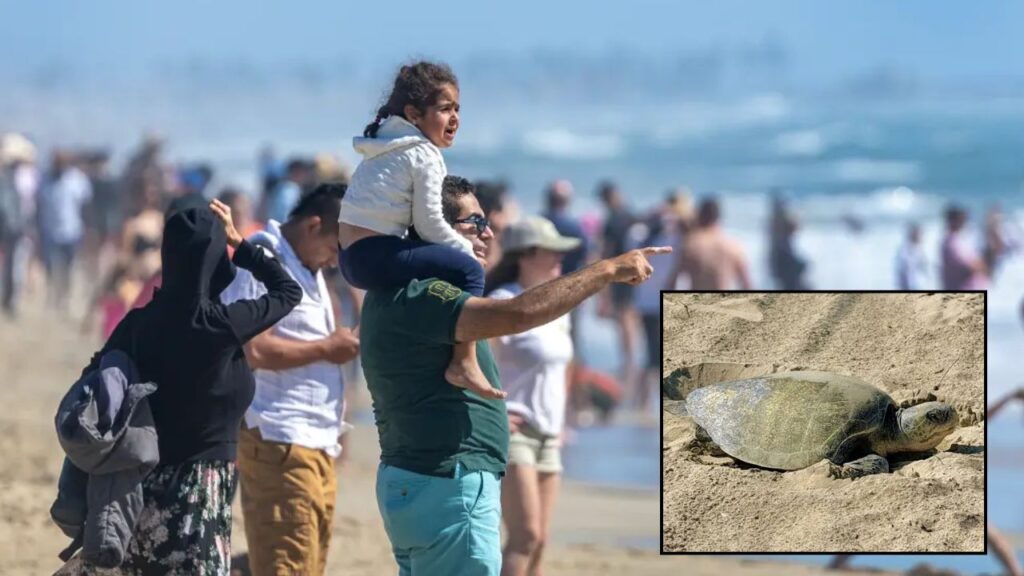
Huntington Beach, California — Two endangered sea turtles have created an unexpected challenge for one of Southern California’s biggest beach events, with nearly 1,400 people signing an online petition calling for the Pacific Airshow to be canceled or postponed.
The dispute centers on two olive ridley sea turtles that recently came ashore and laid nests along the Orange County coastline. The discoveries are especially significant because federal and state wildlife officials have confirmed that the turtles are separate animals, making the nesting event the first recorded natural nesting of any sea turtle species on the U.S. West Coast.
Now the nests are sitting directly in the middle of preparations for the Pacific Airshow, which is scheduled for Oct. 2 through Oct. 4 in Huntington Beach.
Two Rare Nests Discovered Days Apart
The first olive ridley turtle came ashore near Surfside and Seal Beach in mid-September, where it created a nest along the coastline.
Just three days later, another olive ridley turtle arrived farther south and laid eggs near the Huntington Beach Pier on Sept. 19. The timing has created an unusual conflict because olive ridley eggs generally require about 45 to 60 days to hatch.
That means both nests will still be within their incubation periods when thousands of visitors are expected to descend on the beach for the three-day airshow.
One of the nests is located near the pier in an area expected to experience particularly heavy pedestrian traffic during the event.
Officials Are Protecting the Nesting Areas
Wildlife agencies are taking precautions to keep people away from the nests.
The National Oceanic and Atmospheric Administration, U.S. Fish and Wildlife Service, California Department of Fish and Wildlife and state and local partners have fenced off the protected areas and placed warning signs around them.
The nesting sites are also being monitored around the clock as officials watch for any additional activity. The measures are designed to prevent people from accidentally disturbing the nests or coming too close to the protected turtles and eggs.
However, the airshow itself remains scheduled to proceed.
Jet Noise Raises Additional Concerns
The issue is not simply about crowds walking across the beach. The Pacific Airshow features high-performance military aircraft flying over the coastline, raising concerns among some wildlife advocates about noise and ground vibrations generated during the event.
Some advocates worry that repeated aircraft noise and vibrations could affect the developing turtle embryos beneath the sand.
However, the potential effects of those low-frequency vibrations on reptile embryos in loose beach sand remain largely unstudied on the West Coast.
That uncertainty has added another layer to the debate surrounding the event.
Climber Plunged Nearly 500 Feet Down Mount Shasta—Then Crawled to Safety With No Phone or Water
There is currently no clear evidence establishing that the airshow would harm the developing eggs, but the lack of research has prompted additional concern from people seeking greater protections for the nests.
Airshow Organizers Are Changing Ground Operations
While the flight schedule remains unchanged, organizers and Huntington Beach officials are making adjustments to activities taking place on the ground.
Some pedestrian routes, vendor booths and other attractions are being moved away from the protected nesting areas. The goal is to reduce foot traffic and human activity immediately around the locations where the turtles laid their eggs.
The protected areas will remain fenced and monitored throughout the event. For now, however, the aircraft portion of the Pacific Airshow is still expected to take place as scheduled.
Petition Cannot Automatically Cancel the Event
The online petition has attracted nearly 1,400 signatures, with supporters calling for the event to be canceled or postponed because of the turtle nests.
But the petition itself does not have the authority to shut down the airshow.
Any decision involving a cancellation, postponement or relocation would require action involving the city of Huntington Beach and the federal and state agencies responsible for protecting the endangered turtles.
That leaves officials balancing a major public event against the need to protect an exceptionally rare wildlife occurrence.
More Turtles Could Still Appear
The discovery of two separate nesting turtles has also changed what wildlife officials are watching for along the coast. Experts initially believed that a single turtle may have been responsible for both nests. Further analysis of the animals’ body shapes and distinctive shell patterns confirmed that two different olive ridley turtles had come ashore.
Wildlife officials are now continuing to monitor the coastline for signs that additional turtles could arrive and create more nests.
For Huntington Beach, the situation has turned a familiar October tradition into an unusual environmental challenge. The Pacific Airshow remains scheduled, while officials work to protect two rare nests that could represent an important milestone for sea turtles along the U.S. West Coast.
What do you think should happen with the Pacific Airshow while these endangered turtle nests are being protected? Share your thoughts in the comments below.